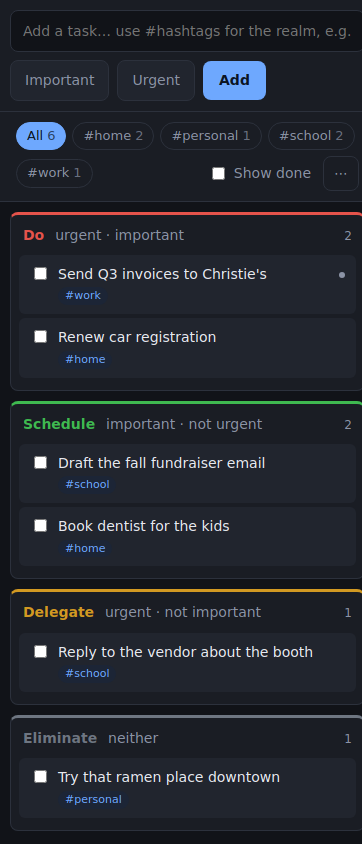
Airlock is a tiny capture surface for the things that fly through your head all day — the call you need to return, the form that's due, the idea you'll lose by lunch. Type it, tag it, and it lands in the right place. Free, on every device you own.
Works in any browser. Adds to your phone's home screen in two taps. Free and open source.

The moment a task occurs to you is the worst moment to decide what to do about it. You're in a meeting, in traffic, halfway through something else. So most apps lose the task at exactly that point, because they ask for a project, a date and a priority before they'll take it.
Airlock separates the two jobs. Capturing is one line of text and two yes/no flags, fast enough to do without breaking stride. Triage happens later, when you sit down with the whole board in front of you and can see what's actually worth doing, what can wait until Thursday, what someone else should handle, and what was never worth doing in the first place.
Half of what you catch will turn out to be noise. That's the point: you find that out on your own schedule, not in the middle of your day.
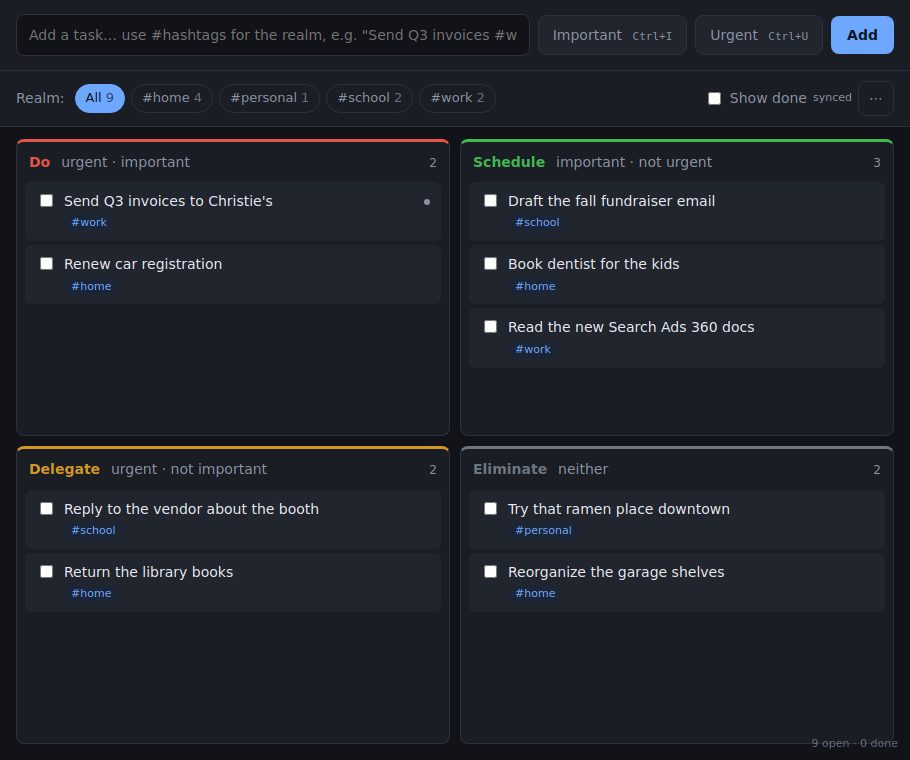
The Eisenhower Matrix is a fifty-year-old sorting rule that still works because it fixes a specific bug in human attention: we treat urgent things as important things. Airlock puts every task in one of four boxes based on two questions.
Do — urgent and important.
The clock is running and the outcome matters. Suit up, do it now.
Schedule — important, not urgent.
The work that moves the ship forward and never sounds an alarm. Put it on the flight plan or it drifts forever.
Delegate — urgent, not important.
Somebody needs it now, but it doesn't need to be you. Delegate it, automate it, or knock it out and move on.
Eliminate — neither.
Dead weight. Most of what lands here should go out the airlock, and letting it go is the whole point.
You don't have to think about the boxes while capturing. Flip Important and Urgent on or off and the card sorts itself. Drag it later if you were wrong.
Add a hashtag and the task belongs to a realm: #work, #home, #kids, #taxes, #band, whatever your life is made of. One tap on a realm filters the whole board to that slice, so at your desk you see only work and at the hardware store you see only home.
Realms are created just by using them. Typing # shows the ones you already have.
Text, tags, two toggles, Enter. No fields, no pop-ups, no "create a project first."
Phone, laptop, desktop — sign in once on each and a task caught on one shows up on the others in about a second. No signal? Capture anyway; it syncs the moment you're back.

Airlock is a web app that installs like a native one. No app store, and updates arrive on their own.
Open the app and sign in with Google or an email code. In Chrome or Edge, click Install in the address bar for a standalone window. In Safari on a Mac, File → Add to Dock.
Open the app in Chrome or Firefox → menu → Add to Home screen.
Open the app in Safari → Share → Add to Home Screen. (Other iPhone browsers can't install web apps.)
Prefer a real app that launches at startup? Download the installer. Windows may warn that the publisher is unknown; choose More info → Run anyway.
Yes. Airlock is a side project from New Orbit Digital. If it ever costs money to run at scale, existing users will hear about it well in advance, and export is always one click.
In a hosted Postgres database (Supabase, US region). Details in the privacy policy.
Menu → Export my tasks downloads everything as JSON. Delete my account removes it all, immediately.
Yes. Changes queue on the device and sync when you're back online.
The web app installs like one (see above). Native builds may come if people ask.
Yes. The whole app — web, desktop and the database setup — is on GitHub under the MIT license. Read it, fork it, run your own copy against your own database.
Justin, who runs a small paid-search agency and got tired of losing tasks between a client call and the school pickup line. Airlock started as a tool for one person and still behaves like one.